Showing posts with label Malaysia. Show all posts

WHY THE NEED FOR LOCAL COUNCILS?

(Bernama) – Parti Keadilan Rakyat (PKR) president Datuk Seri Dr Wan Azizah Wan Ismail today praised Selangor’s administration under Mentri Besar Tan Sri Abdul Khalid Ibrahim for having set aside allocation for implementation of various economic programmes in the state.
However, she said, Abdul Khalid should also pay attention to people’s issues, like “rubbish and road”.
“Although we are proud of the achievement, we should also be sensitive to people’s issues like those related to rubbish and road.”
“If basic facilities for the people are neglected, the state reserves brings no meaning,” she said in the presidential policy speech at the PKR’s 10th National Congress here yesterday.
She said the state administration under Abdul Khalid was often criticised for not building new infrastructure facilities, as well as maintained existing ones, despite having huge cash reserves.
Dr Wan Azizah said infrastructure projects had to be carried out so that the Selangor people would benefit from the state government’s funds.
************************************
What Dr Wan Azizah Wan Ismail said yesterday is actually very true. However, before we discuss this issue, let us first understand the role of governments. And please forgive me if what I am about to say sounds a bit academic or like an essay for a course in political philosophy.
In the beginning, humankind did not have governments. That, of course, was in the era of the hunter-gatherer when people lived a nomadic life and survived off the land, and then moved on somewhere else when the land could no longer sustain life.
When the community eventually grew too large, and there were too many communities within walking distance from one another, it was no longer possible to live the life of a nomad.
One reason was wherever they wanted to migrate to was already inhabited plus moving a large body of persons to a new area is not as easy as, say, moving just one family or a small community.
That was when communities settled down and built a life where they lived. And that meant they could no longer survive as hunter-gatherers but had to transform into farmers (they had to replace the food they scavenged off the land) plus they had to rear livestock (they had to replace the animals they killed and ate).
When communities become too large, they need rules. So laws were introduced. You were not allowed to steal from others or kill your neighbours or rape their wives and daughters. The weak needed to be protected from the strong because the strong will always try to dominate and bully the weak (it is human nature even until today).
Once you have decided to have laws or rules then you need someone to formulate them and determine what can and cannot be done. So you need the lawmakers, who will usually be the elder or elders in the community, maybe a committee of elders who the community has chosen to represent their interests.
Once the laws are in place you now need a judicial system, a body that sits to hear complaints regarding violations of these rules or laws and judges whether this allegation is in fact true and what to do with these lawbreakers and what punishment they should be subjected to.
This would be the process for the implementation of the laws but if you want them to be implemented properly then you need a sort of police force tasked with the job of this implementation. If you cannot enforce these laws then it would be futile to have laws.
So, eventually, communities began to have lawmakers, enforcers and judges and everyone lived within this system, what we would call a government (elected or otherwise). And anyone who did not wish to live under a government can opt to leave that community and become what we would call anarchists — people who reject governments or organised communities.
Eventually, the community became even larger and these governments became more complex and the community demanded more from its government. There was the matter of development (social needs), defence (from the attacks of other communities), and much more.
So a system of tax was introduced so that water could be supplied to the community, roads built, guards employed to patrol the streets, and so on. The individual could no longer do this. The government needed to do it and they needed money to do it, which the people paid for through the tax that was levied.
We have come a long way since then but the process more or less still remains the same and the reason why we do this also still remains the same. However, the system of government today is a bit more complex than what humankind first started 10,000 years or so ago.
Let us talk about Selangor, in response to what Dr Wan Azizah said yesterday (and what Anwar said today at the PKR national congress).
Malaysia, as do most countries, has a federal government that decides on national policies and looks after foreign relations, national defence, internal security, etc., which is headed by a prime minister and his/her federal cabinet.
Then we have state governments that are in charge of state resources (water included but not oil and gas), religion (meaning Islam), and development that comes under state jurisdiction (but not including federal roads/highways and federal agency infrastructure such as schools, military camps, police stations, etc.).
The menteri besar or chief minister and his/her state cabinet or Exco head this state government.
While the prime minister heads the federal government, his/her cabinet decides the policies and brings these proposals to the cabinet for approval. As Anwar Ibrahim said many times when he was still in the Barisan Nasional government, the entire cabinet is collectively responsible for cabinet decisions because it is a cabinet decision and not the sole decision of the prime minister or minister in charge of his/her ministry.
This was what Anwar used to say.
Hence you cannot blame Anwar alone for his education policies when he was the Education Minister, or blame Tun Dr Mahathir Mohamad alone. Whatever was done was a cabinet decision, not a one-man decision.
The same goes for the state government. We cannot blame Mat Taib or Khir Toyo alone for how Selangor was run. We need to blame Umno and/or Barisan Nasional. Hence we cannot just replace the Umno menteri besar. We need to kick out Barisan Nasional and change the whole government. It is no use kicking out just the menteri besar if Barisan Nasional is still the government.
This was what Anwar used to say.
So now we have complaints regarding, as Dr Wan Azizah said, “rubbish and roads”. This is why, according to Dr Wan Azizah, Khalid Ibrahim needs to be kicked out.
But who is the one in charge of rubbish and roads (meaning state roads, not federal roads)? Is it not the Exco member in charge of local government, a DAP state representative? And hence, also, would not the local councils come under him?
And is it not the entire Exco and not just the menteri besar that decides the policies? And does the Exco in charge of local government not table his plans, policies and budget at the state Exco meeting for the approval of the entire Exco?
If anyone should be blamed for the failure of the local governments then it should be the Exco member in charge of local government. But it is not his fault alone, just like Anwar cannot be blamed for the deterioration of Malaysia’s education system that started when he was the Education Minister.
Anyway, local councils have local councillors. And these are the people who are supposed to decide the policies of their local councils and make sure that the rubbish is collected and the damaged roads are repaired. They decide what is done and how much money is spent to do it.
And who are these local councillors? Are they not members of PKR, DAP and PAS and are they not nominated by PKR, DAP and PAS? Hence the local councils are run by PKR, DAP and PAS representatives and report to the DAP Exco member who then reports to the Exco.
Are you saying that the menteri besar personally instructs the heads of the local councils, by-passing the local councillors, Exco member in charge of local government, and the entire EXCO?
If so then why did the DAP Exco member in charge of local government say that he does not share the view of the others that Khalid Ibrahim failed to do his job properly? And why did the PAS Exco member say that they could only get money if backed with a proper working paper with sound justification as to why the money should be spent?
In the past, in the days when Umno was running Selangor, they ‘created’ projects as a means to siphon out money. They developed areas that really did not need development (like plant flowers, pave the sidewalks, etc., every few months) so that the councillors can make money from kickbacks.
I have seen perfectly good sidewalks torn up and repaved at great cost, many times more than twice or three times what it should have cost. And many of these jobs were given out to friends and family on a non-tender, negotiated basis.
We have to be very careful that once Khalid leaves and a new menteri besar takes over, Selangor does not revert to the old Umno ways of doing things. RM3 billion is a lot of money but even RM3 billion will not last if we develop the state not because it needs development but because certain people want to make money from kickbacks.
And if the menteri besar and not the councillors decide how the local government operates and what it does, then why the need for local councillors? And if we need local councillors because they must run the local councils then why blame Khalid for the “rubbish and roads” problem when it is the local councils under the Exco member for local government that are in charge?
After all, do we blame Anwar or Barisan Nasional for Malaysia’s poor education system?

WHEN AZMIN SPEAKS OF DEMOCRACY

Today, Azmin Ali said that democracy is under attack. He was addressing the PKR youth movement at the party convention this morning. And Azmin was referring to Anwar Ibrahim’s sodomy trial when he said that democracy is under attack. In other words, Anwar’s sodomy trial is proof that democracy is under attack.
It is a shame that political leaders make such vague and sweeping statements. Most Malaysians consider their leaders as smart people so whatever these leaders say Malaysians would believe it.
However, Malaysians do not really understand the concept of democracy or how it works and they think that democracy means holding elections once every five years. Even the ex-Minister of Information, Zainuddin Maidin, thinks so when in 2007 he said that Malaysia is a democratic country because it holds elections every five years.
That is like saying I am a smart person because I speak English. I have met professors in China who do not speak a word of English but are faculty deans of universities that conduct research in grain technology that is far advanced than any English-speaking university.
How do you think China can feed 20% of the world and still have enough food to export?
By the way, just to digress a bit (as usual) I made ten trips to China in the 1990s even as Pudong was still being built and I remember telling my wife that by or before 2020 China is going to overtake the US as the number one economy in the world. (I am very proud of this prediction, of course, and forgive me if I keep repeating this).
In fact, I wrote about this in the mid-1990s (before the days of the Reformasi movement). I even wrote about praying in the oldest mosque in China, which is in Canton (that looks like a Chinese temple), which was built in the 700s and I mentioned how funny it is that Malays call Chinese Muslims mualaf when the Chinese were Muslims 700 years before the Malays discovered Islam. It is the Malays who are actually the mualaf.
Anyhow, back to the subject of the day.
Democracy is a form of government in which all eligible citizens are meant to participate equally — either directly (such as in a referendum) or indirectly through elected representatives — to formulate, develop and implement the laws by which their society is run.
The term democracy originates from the Greek word dēmokratía or rule of the people. Dêmos meanspeople and kratos means power or rule. This concept of government started in the 5th century BC to denote the political systems existing in the Greek city-states at that time, notably Athens.
I call democracy the tyranny of the majority (this is what you will learn if you take a course in Political Philosophy). John Adams introduced this phrase in 1788 and it gained prominence in 1835 in the bookDemocracy in America written by Alexis de Tocqueville.
John Stuart Mill further popularised this phrase in 1859 when he quoted Tocqueville in On Liberty. The phrase was widely employed in the mid-1800s in relation to a series of moral questions that gave rise to organised minority groups in American politics.
Lord Acton also used this phrase in 1877 in The History of Freedom in Antiquity when he said, “The one pervading evil of democracy is the tyranny of the majority, or rather of that party, not always the majority, that succeeds, by force or fraud, in carrying elections.”
In 1965, Herbert Marcuse referred to the tyranny of the majority in his essay Repressive Toleranceregarding tolerance in advanced industrial society. Marcuse said that tolerance is extended to policies, conditions, and modes of behaviour which should not be tolerated because they are impeding, if not destroying, the chances of creating an existence without fear and misery and that this sort of tolerance strengthens the tyranny of the majority against which authentic liberals protested.
So you see, while Malaysian politicians and political activists advocate the virtues of democracy, some of the best brains over the last 2,500 years do not think much of democracy. Democracy is flawed at best and unjust at worse. Democracy is not really the ‘cure all’ for a sick society. It actually raises more problems than it solves.
What, then, is the best system of government or what then is a better system than democracy?
Actually, there is no better or best system. Democracy is merely the least of the many evils such as absolute monarchies, dictatorships, autocracies, and whatnot. Humankind has not yet discovered anything better than the democratic system that we have adopted for Malaysia and many other countries all over the world.
The Islamists will say that democracy, being man-made, is flawed. Speak to any PAS activist, privately and off-the-record, of course, and he or she will tell you that the only perfect system is God’s system, meaning the Islamic State. Publicly they will never say this because that will mean PAS would lose the support of the majority of Malaysians, liberal Malays included.
Hence PAS has to pretend it upholds ‘western’ democracy, for the meantime, until it has enough political power to fulfil its dream of the Malaysian Islamic State.
Not only PAS but Anwar Ibrahim also said that at the moment Malaysia is not ready to implement Islamic laws such as Hudud (although Malaysia already has Sharia laws). Malaysians must first be educated regarding the Islamic State and Islamic laws and once they understand how it works and can accept this new system can we introduce it.
You cannot fault Muslims for thinking that the Qur’an and Allah’s system is the most perfect and surpasses any form of man-made system by far, especially since the Westminster system of government was created by non-Muslims who destroyed the Caliph system of the Ottoman Empire.
Even Mustafa Kemal Atatürk, the Father of Modern Turkey, is considered an apostate by people such as PAS President Abdul Hadi Awang (I have attended his sermons where he said so). Hence the Westminster system of government is no-go as far as Islamists are concerned but they will tolerate it for the meantime until the system can be changed.
Nevertheless, seeing what IS (ISIS, ISIL) is currently doing while giving us an impression that that is what the Islamic State means, even Muslims themselves will prefer the Westminster system above ‘Allah’s system’. Hence these Islamists are doing a great disservice to Islam and the damage they have caused is going to make people reject the Islamic State for a long time to come.
In the absence of a better system, the Westminster system of government can work. After all, it is all we have. But the system can work only if we implement it correctly. Any good system will turn bad if not implemented correctly (Islamic State included).
First, we have four branches of government. We have the Executive, the Legislature (parliament and senate), the Judiciary, and the Monarchy. Each of the four branches must be independent of one other (in other words, one must not interfere in the other) but at the same time all four must work in tandem (complement one other).
Second, we have three levels of government. We have the Federal Government, the State Government, and the Local Government. And, again, each of the three levels must be independent of one other (in other words, one must not interfere in the other) but at the same time all three must work in tandem (complement one other).
That would be how a good government should work (not 100% perfect but as close to perfect as possible). And I say not 100% perfect because 51% and above decide this while the 49% and below have no say in the matter. Worst of all, it is not 51% and above of the voters but those who win 51% and above of the seats — which does not necessarily mean 51% of the voters voted for them (the 2013 general election a case in point).
Most times voters would vote for the party and not for the candidate. Hence the elected representative (called wakil rakyat in Malay, or peoples’ representative) is not really the peoples’ representative but the party’s representative. Hence they serve their party rather than the people who voted for them.
This is one problem.
The next problem is only the parliamentarians and state assemblypersons are elected into office. The local government councillors are not. They are appointed, like the Senators.
Now, the senate is supposed to be the auditor or watchdog of parliament. When parliament passes laws it goes to the senate for debate and if the senate feels that that particular law is unjust, ambiguous, contradictory, violates the Constitution, etc., it sends the bill back to parliament.
However, since the senators are also appointed nominees of their respective parties, most times (or all times) the senate does not contradict parliament. Hence what we get is a rubber-stamp senate that might as well be abolished.
The monarchy too, since Tun Dr Mahathir Mohamad’s time, has had it wings clipped so even if the Agong (or state ruler) does not sign any bill into law it still gets automatically passed into law. So the monarchy, too, has in a way been reduced to a rubber-stamp monarchy.
As I said, the Westminster system of government is not 100% perfect but it can be improved if we restore Malaysia’s system of government to what it should be. We must restore the four branches and three levels of government and we must have the senate and local government an elected body (not appointed like now).
Most importantly, though, democracy means, as how the Greeks intended it to be 2,500 years ago, adēmokratía or rule of the people. Hence the people must rule themselves. Currently, the people transfer the mandate to rule to political parties to do what they like.
And it is up to you, the voters, to decide whether you want people’s power or party’s power as your government. And once you go to the polls and mandate the political parties to represent you in government, there is very little you can do until the next polls.
There are actually good people and bad people on both sides of the political divide. Alas, election after election the voters will vote along party lines. That means good people will get kicked out because they belong to the ‘wrong’ party while bad people will get voted in because they belong to the ‘right’ party.
And ‘right’ and ‘wrong’ is interpreted as the party you belong to. And that is why democracy does not quite work the way it should, especially when less than 50% of the voters can decide what government you are going to have.
Anyway, don’t feel too bad about it. Hitler democratically got into power with only 30% support and tens of millions were killed in WWII after that. That, unfortunately, is how democracy works.


OUTSPOKEN: Can any oil producing country in the world make all her citizens millionaires via prudent management and savings?
Norway achieved that on Jan 8, 44 years after striking oil in the North Sea in 1969. But it only set up its oil sovereign wealth fund (SWF) in 1990, meaning it took the Norwegians only 23 years to be millionaires.
According to a Reuters report, everyone in Norway became a theoretical crown millionaire on Jan 8 in a milestone for the world’s biggest sovereign wealth fund that has ballooned thanks to high oil and gas prices.
The fund owns about one per cent of the world’s stocks, as well as bonds and real estate from London to Boston, making the Nordic nation an exception when others are struggling under a mountain of debts.
A preliminary counter on the website of the central bank, which manages the fund, rose to 5.11 trillion crowns (US$828.66 billion or RM2.7 trillion), fractionally more than a million times Norway’s most recent official population estimate of 5,096,300.
It was the first time it reached the equivalent of a million crowns each, central bank spokesman Thomas Sevang said.
Not that Norwegians will be able to access or spend the money, squirreled away for a rainy day for them and future generations. Norway has resisted the temptation to splurge all the windfall since its oil strike.
Finance Minister Siv Jensen told Reuters the fund, called the Government Pension Fund Global, had helped iron out big, unpredictable swings in oil and gas prices. Norway is the world's number seven oil exporter.
“Many countries have found that temporary large revenues from natural resource exploitation produce relatively short-lived booms that are followed by difficult adjustments,” she said in an email.
The fund, equivalent to 183 per cent of 2013 gross domestic product, is expected to peak at 220 per cent around 2030.
“The fund is a success in the sense that parliament has managed to put aside money for the future. There are many examples of countries that have not managed that,” said Oeystein Doerum, chief economist at DNB Markets.
Note the key word: Parliament. In Malaysia, only the prime minister has access to national oil producer Petronas’ funds and accounts.
Malaysia is the 27th largest oil producer in the world, rolling out 693,700 barrels/day. Only 114 countries were listed as at 2009 and 2010. Norway rolls out 2,350,000 bbl/day.
What’s the financial position of Malaysia? A federal debt of up to RM800 billion! (as revealed by then Deputy International Trade and Industry Minister Datuk Seri Mukhriz Mahathir at end of 2012).
And do we have such an oil SWF to save for rainy days for the rakyat and country? None.
According to a written reply in Parliament by Prime Minister Datuk Seri Najib Razak, Petronas had contributed RM3 billion to the National Trust Fund (or Kwan, the acronym for Kumpulan Wang Amanah Negara) as at June 2011.
He also said the money had been invested in various financial instruments and that Kwan’s fund currently stood at RM5.43 billion.
Just a measly RM5.43 billion compared with Norway’s RM2.7 trillion!
The administration and management of the trust is handled by Bank Negara with a panel under Kwan monitoring the collection of funds.
And, digest this moronic joke: Najib said Kwan was set up to ensure that revenue from dwindling natural resources would benefit future generations.
After 39 years (Petronas was founded in 1974), all we have today is a federal debt of at least RM800 billion, and the international reserves of Bank Negara Malaysia stood at RM441.7 billion (equivalent to US$134.9 billion) as at Dec 31, 2013.
Now, it is clear why the Umno-led Barisan Nasional government is cutting down on subsidies. Its federal debt is so high that it cannot continue to borrow to serve the rakyat as before or Malaysia will go bust like Greece.
It’s time for Malaysians to take stock of the federal government’s lack of transparency and accountability in its financial management of the country’s wealth.
It’s utter nonsense and a disgrace for the 24-year-old Kwan to have a paltry savings of RM5.43 billion, unless Najib now wants to claim that the figure was erroneous and blame it on a scapegoat who prepared the written reply in Parliament.
What can RM5.43 billion (US$1.9 billion) do to help Malaysians and Malaysia during rainy days, like when our oil wells run dry?
Why is there no oil-based SWF for Malaysia?
Petronas is today a global player in oil and gas exploration.
Why is the government just satisfied with an annual RM100 million contribution to Kwan since 1988?
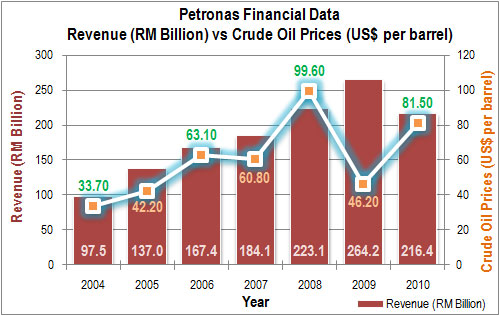
Where has Petronas’ hundreds of billions of ringgit in revenue over the past 38 years gone to?
Did Petronas’ oil and gas exploration presence in 32 countries outside Malaysia also contribute or help facilitate the bulk of the RM1.08 trillion in capital flight in the last decade?
Why avoid establishing an oil-based SWF for the people and country? Is it because financial transparency and accountability would be a pain?
Crude oil and natural gas are Malaysia’s two most abundant resources but their sustainability is being questioned with the country projected to become a net oil importer in a few years.
Now, let’s take a more detailed look on why other oil producing countries are doing better in terms of oil-based or non-commodity-based SWF management:
Kuwait (10th at 2,494,000 bbl/day), Libya (17th at 1,790,000 bbl/day), Kazakhstan (18th at 1,540,000 bbl/day), Algeria (15th at 2,125,000 bbl/day), South Korea (64th at 48,180 bbl/day) and Singapore (82nd at 10,910 bbl/day).
Malaysia’s non-commodity Khazanah Nasional, founded in 1993, is ranked 23rd with US$34 billion (RM110 billion) in assets and a Linaburg-Maduell Transparency Index (LM-TI) of 5.
The world’s largest SWF, Norway’s Pension Fund Global, was in 2009 registered with assets worth US$664.3 billion (RM2 trillion) with a perfect 10 LM-TI.
UAE-Abu Dhabi’s oil-based Abu Dhabi Investment Authority, established in 1976, is ranked second with US$627 billion (RM2 trillion) and a 5 LM-TI.
At third spot, China’s non-commodity SAFE Investment Company, which was founded in 1997, now manages assets worth US$567.9 billion (RM1.8 trillion), with a 4 LM-TI.
That’s the top three SWFs in the world. Now, let’s focus on our neighbours.
Singapore’s non-commodity Government of Singapore Investment Corporation, which was set up in 1981, is ranked 8th with assets at US$247.5 billion (RM802 billion) and a 6 LM-TI.
Following at 9th rank is another Singapore non-commodity SWF, Temasek Holdings, which was established in 1974. It has US$157.5 billion (RM510 billion) in assets and a perfect 10 LM-TI.
Even countries like Kuwait, which was severely damaged by Iraq’s bombing and brief occupation, Libya, Kazakhstan, Algeria and South Korea, which were far poorer than Malaysia in the 60s, 70s and 80s, are all managing their country’s wealth better than Malaysia.
Malaysia’s economic and financial standing is baffling, don’t you think so?
Ng Kee Seng believes that God helps those who help themselves. In a healthy democracy, every Malaysian has a role in politics and nation-building.

Tak sukar untuk memahami sejarah IPP di Malaysia. Kami akan guna bahasa & penjelasan yang cukup mudah difahami disebalik perjanjian IPP yang telah memberikan tekanan yang cukup hebat kepada TNB, PETRONAS dan juga anda sebagai rakyat Malaysia yang merupakan pengguna tenaga elektrik di Malaysia….
Semuanya bermula pada tanggal 31 Mac 1993, Tenaga Nasional Berhad (TNB), pembekal utama tenaga di Malaysia yang juga merupakan syarikat berkaitan dengan kerajaan (GLC) telah menandatangani Perjanjian Pembelian Tenaga (Power Purchase Agreement) dengan Pengeluar Tenaga Bebas (Independent Power Producer – IPP) iaitu Yeoh Tiong Lay Corporation Bhd (YTL).
Ini merupakan perjanjian PPA yang pertama ditandatangani oleh TNB dengan IPP untuk operasi Stesen Janakuasa Bebas Paka dan Pasir Gudang. Perjanjian PPA yang pertama ini akhirnya telah membuka pintu kepada taikun-taikun tersohor Malaysia pada masa itu untuk bersama-sama menjadi kalangan pemain utama industri IPP di Malaysia. Akhirnya pada akhir tahun 1993 monopoli TNB dipecahkan dalam sektor pembekalan tenaga negara apabila tertubuhnya 5 IPP yang berperanan membekalkan 30.99 peratus bekalan elektrik kepada Grid Kebangsaan.
  1. YTL Power Generation Sdn. Bhd. – Tan Sri Dato’ Seri Dr. Yeoh Tiong Lay (Pemain pertama yang menandatangani PPA dengan TNB)
  2. Segari Energy Ventures Sdn. Bhd – Tan Sri Syed Mokhtar Al-Bukhary
  3. Port Dickson Power Bhd – Tan Sri T. Ananda Krishnan
  4. Powertek Bhd - Tan Sri T. Ananda Krishnan
  5. Genting Sanyen Power Sdn. Bhd. – Tan Sri Lim Goh Tong
Setiap apa yang terjadi pasti ada puncanya. Apa puncanya sehingga munculnya IPP dalam industri tenaga negara?
  • Semuanya bermula apabila berlakunya blackout yang terburuk pada tahun 1992 sehingga menyebabkan sebahagian Malaysia “gelap-gelita” selama tempoh 48 jam dan mencetuskan kemarahan & bantahan orang awam
  • Akibatnya, Tun Dr Mahathir Mohamad telah menyalahkan monopoli TNB dalam penjanaan tenagaan elektrik negara di atas masalah yang berlaku pada tahun 1992 itu
  • Akhirnya, IPP telah diberikan peranan dalam sektor industri tenaga negara
Pada masa itu apabila peluang dibuka untuk kontrak IPP, ramai yang membida kontrak IPP sehingga sekitar 150 permohonan telah masuk dalam Unit Perancang Ekonomi (EPU) termasuklah jutawan dan taikun tersohor Malaysia pada masa itu seperti :
  • Jutawan seperti Yeoh Tiong Lay (YTL)
  • Ananda Krishnan (Maxis)
  • Lim Goh Tong (Genting)
  • Syed Mokhtar Al-Bukhary (MMC Corporation)
Mereka juga turut berminat dengan kontrak lumayan IPP ini walaupun mereka tidak mempunyai pengalaman dalam industri tenaga negara. Mana tidaknya :
  • Kontrak lumayan diikat untuk tempoh yang lama (21 tahun)
  • Keuntungan IPP akan dijamin pulangan oleh kerajaan sebanyak 20% (minimum)
Kontrak IPP mencapai ke kemuncaknya menjelang 1997, sebelum bermula krisis ekonomi Asia di mana Malaysia pada masa itu mempunyai lebihan keupayaan tenaga sehingga hampir 50%. Akhirnya yang terkesan TNB juga :
  • TNB wajib membeli tenaga daripada IPP walaupun TNB sebenarnya tidak memerlukan tenaga tersebut. Tetapi di atas dasar perjanjian “berat sebelah” PPA, TNB terpaksa juga membelinya
  • Sehinggalah berlakunya krisis ekonomi 1997, TNB mengalami kerugian yang terburuk dalam sejarah
  • Penyelesaiannya mudahnya tarif elektrik terpaksa dinaikkan kepada anda, anda dan anda semua sebagai pengguna elektrik
Gelombang kedua IPP berlaku pada tahun 2001. Walaubagaimanapun kontrak IPP pada pada masa itu “tidak semewah” dan “kurang istimewa” sebagaimana yang dinikmati oleh pemain-pemain IPP semasa gelombang pertama pemberian kontrak IPP.
Walaubagaimanapun, TNB tidak keseorangan kerana Petronas juga sebenarnya turut menerima “bala” dan menjadi “budak belasahan” akibat wujudnya gelombang pertama IPP di Malaysia. Petrolium Nasional Berhad (Petronas) yang ditubuhkan sejak tahun 1974 lagi turut “diperah” hasil yang diperolehi mereka.
Sejak tahun 1997 sehingga tahun kewangan 2010, subsidi gas Petronas yang terkumpul pada jumlah yang boleh dikatakan pada angka yang mengejutkan iaitu sebanyak RM116.4 bilion. IPP sendiri menikmati sebahagian limpahan subsidi sebanyak RM49.3 bilion (42.3%) diikuti dengan TNB (RM37.3 bilion atau 32%) dan lain-lain seperti kecil perindustrian, perdagangan, pengguna kediaman dan NGV menikmati RM29.8 bilion atau 25.6%. Secara faktanya, IPP dan TNB sahaja sudah menikmati sejumlah RM86.6 bilion atau 74.4% daripada jumlah subsidi gas sejak tahun 1997 lagi.
Setakat ini, Petronas telah membayar sejumlah RM529,000,000,000,000 (RM529 bilion) kepada Kerajaan Persekutuan & Kerajaan Negeri, menjadikan Petronas adalah penyumbang terbesar “peti simpanan negara”. Sepatutnya keuntungan Petronas adalah berlipat kali ganda daripada yang diperolehi sekarang ini tetapi subsidi yang tinggi diberikan kepada kepada IPP dan TNB telah mengambil sebahagian besar daripada keuntungan bersih Petronas.  Setiap tahun, Petronas membayar berbilion-bilion ringgit dalam bentuk subsidi gas terutamanya oleh IPP dan TNB.
Pada tahun 2005, 40.5% kos operasi TNB telah dibelanjakan untuk membeli elektrik daripada IPP. Bagi tahun kewangan 2010, kos tenaga TNB meningkat sebanyak 2.4% kepada daripada
  • RM16.974 billion (tahun 2009)
  • RM17.379 billion (tahun 2010)
Ini semua disebabkan pembayaran yang lebih tinggi kepada Pengeluar Tenaga Bebas (IPP) berjumlah RM12.528 billion meningkat sebanyak 5.9 % berbanding tahun sebelumnya (RM11.827 billion). Disebabkan kos bahanapi yang rendah, sekurangnya TNB masih boleh untuk menyerap tekanan kos pembelian tenaga yang tinggi daripada IPP.
Tak sukar untuk IPP buat untung atas angin sehingga menekan TNB, Petronas dan seluruh pengguna elektrik di Malaysia :
Inilah yang dinamakan “skim cepat kaya” khas tanpa sebarang risiko untuk golongan atasan supaya mereka terus menggungguli takhta senarai individu terkaya di Malaysia.
P/S : Jadi sekarang ini siapa yang menerima subsidi antara yang terbesar di Malaysia? Mana yang lebih penting, subsidi kepada rakyat kebanyakan atau taikun-taikun kaya di Malaysia?

Elektric